

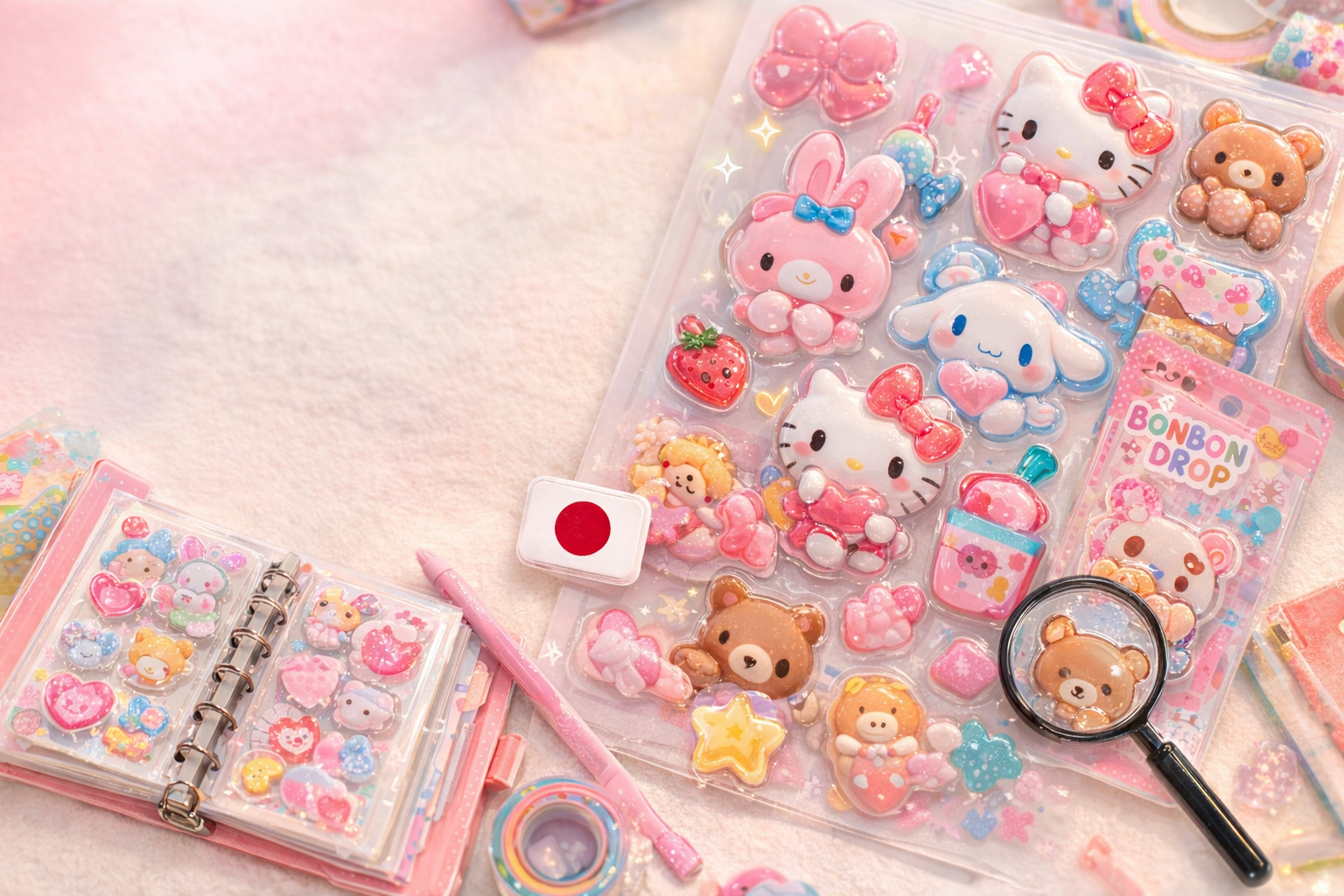
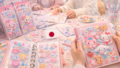
Bonbon Drop Seal stickers are one of the cutest Japanese stationery trends in recent years. They are not flat stickers in the usual sense. Instead, they are glossy, raised PVC stickers with a rounded, resin-like look that makes them feel closer to tiny decorative objects than ordinary seals. Sun-Star’s official product pages list them as PVC items, and Q-LiA’s store describes them as shiny, puffy 3D stickers that look “as if made from resin.”
That mix of texture, shine, and collectibility is a big part of the appeal. Bonbon Drop Seal is easy to understand at a glance: it is cute, tactile, and highly photogenic. It fits perfectly into the kind of Japanese stationery trend that feels fun to use, fun to display, and even fun to collect without using at all.
- What are Bonbon Drop Seal stickers?
- Why are Bonbon Drop Seal stickers so popular in Japan?
- What makes Bonbon Drop Seal stickers different from regular stickers?
- Bonbon Drop Seal stickers and Japan’s wider sticker culture
- Popular Bonbon Drop Seal designs and character series
- Are Bonbon Drop Seal stickers only for kids?
- Where can you buy Bonbon Drop Seal stickers in Japan?
- How to tell real Bonbon Drop Seal stickers from fakes
- A simple rule for overseas buyers
- Are Bonbon Drop Seal stickers worth buying?
- Final thoughts
- Need help sourcing Bonbon Drop Seal stickers from Japan?
What are Bonbon Drop Seal stickers?
Bonbon Drop Seal is a product line sold by Sun-Star Bungu and developed with Q-LiA. Sun-Star’s official explanation states that the stickers are planned by Q-LiA and Sun-Star Bungu, manufactured by Q-LiA, and sold by Sun-Star Bungu. The same page also says that “Bonbon Drop” is a registered trademark of Q-LiA.
On official product pages, Bonbon Drop Seal items are shown in compact packaged formats and priced at ¥550 including tax for releases such as the Sanrio series, with PVC listed as the material. Sun-Star’s product pages also show that both standard and mini versions have been released, which makes the line feel like an expanding series rather than a one-off novelty.
Why are Bonbon Drop Seal stickers so popular in Japan?
The first reason is visual appeal. These stickers are glossy, thick, and dimensional in a way that feels much more luxurious than ordinary flat stickers. Q-LiA’s product descriptions repeatedly emphasize the shiny, plump, resin-like look and the kind of design variety that makes you want to collect the whole series.
The second reason is variety. Bonbon Drop Seal is not limited to one style. Sun-Star’s official Bonbon Drop tag pages show character and franchise expansions including Sanrio, Disney, PEANUTS, Chiikawa, Tamagotchi, mofusand, and more, while Q-LiA’s store also carries many non-character original designs. That gives the trend a much wider audience than a single character line would have.
The third reason is that it became a genuine trend item. Q-LiA’s shop itself describes the line as something that has been a hot topic on social media, and reporting from late 2025 noted that Bonbon Drop-style 3D stickers had become so popular that many stationery stores sold out.
What makes Bonbon Drop Seal stickers different from regular stickers?
The biggest difference is texture. Regular stickers are usually flat and paper- or film-based. Bonbon Drop Seal stickers are thicker, glossier, and raised, with a surface that looks more like coated resin or candy. That is why they feel decorative even before you use them.
They also come with product characteristics that would be unusual for ordinary stickers. Sun-Star’s customer information notes that bubble amount, glitter amount, surface hardness, and resin quantity can vary from item to item, and that these differences are part of the product’s nature. That makes sense for a dimensional item where the visual finish is part of the charm.
Bonbon Drop Seal stickers and Japan’s wider sticker culture
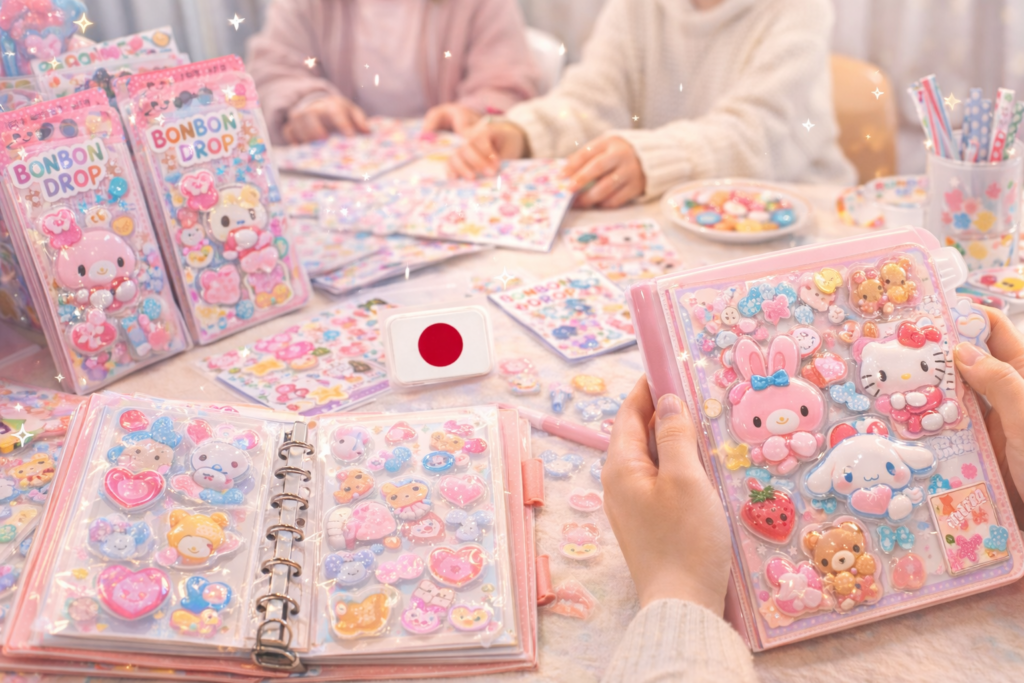
Part of what makes Bonbon Drop Seal interesting is that it is not popular in isolation. In Japan, sticker collecting and sticker swapping have been gaining attention again. An exhibitor announcement for Bungu Joshi Haku in Osaka in 2026 explicitly says that renewed interest in Heisei-era culture has brought attention back to “sticker activities” centered on collecting and exchanging stickers. The same announcement highlights related products such as backing sheets designed to hold even raised stickers securely.
That wider context helps explain why Bonbon Drop Seal feels bigger than a single cute product. It fits naturally into a culture where people collect stickers, organize them in sticker books and binders, and care about how to store and swap them without damage. A puffy sticker with a strong visual identity works especially well in that kind of collecting culture.
There is even a sticker exchange café in Tokyo. Rurubu Kids reports that Sharepuku Harajuku, which opened in December 2025, is a sticker exchange café where visitors can swap stickers with staff and other customers, and can also buy stickers inside the venue. That shows how sticker culture in Japan has moved beyond just shopping and into something more social.
In that environment, Bonbon Drop Seal makes perfect sense. It is cute enough to collect, distinctive enough to trade, and visually striking enough to stand out in a sticker book or exchange setting.
Popular Bonbon Drop Seal designs and character series
One reason the trend feels so visible is that Bonbon Drop Seal is not limited to one kind of buyer. Sun-Star’s official listings show licensed series such as Sanrio Characters, while its Bonbon Drop tag pages also include Disney, PEANUTS, Chiikawa, Tamagotchi, and other recognizable names.
That matters because it widens the appeal. Some buyers want obvious kawaii character stationery. Others prefer animals, food motifs, or softer non-character designs. Q-LiA’s online store shows exactly that kind of spread, with original Bonbon Drop designs that go beyond licensed characters.
Are Bonbon Drop Seal stickers only for kids?
Not really. The character versions may look child-focused at first glance, but the product is also very easy to understand as a collectible stationery item for teens and adults. Official descriptions focus on visual enjoyment, collecting, and design variety rather than presenting the line only as children’s stationery.
In practice, Bonbon Drop Seal fits especially well into the broader world of kawaii Japanese stationery, where the appeal often comes from small, joyful, giftable items with a strong visual identity. These stickers work well in journals, on packaging, in sticker books, and as little souvenirs.
If you want a broader overview of cute stationery beyond this trend, see our guide to kawaii Japanese stationery.
Where can you buy Bonbon Drop Seal stickers in Japan?
Official brand pages do not provide a public master list of every store carrying each release. Sun-Star’s customer information specifically says it does not provide individual handling-store guidance. That means availability can vary, especially for popular designs.
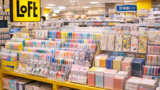
In practical terms, Bonbon Drop Seal is the kind of item you are most likely to find in Japanese stationery stores, character-goods shops, larger lifestyle retailers, and selected online stores. Q-LiA’s official store carries many Bonbon Drop products, and Sun-Star’s product pages confirm the official licensed releases.
If you are planning a trip and want broader shopping guidance, see our guide to where to buy Japanese stationery in Japan.
If you are especially checking larger variety stores, our Loft Japanese Stationery Guide may also help.
How to tell real Bonbon Drop Seal stickers from fakes
Because Bonbon Drop Seal stickers became so popular, counterfeit versions are now circulating online, on flea-market apps, and even in some physical shops in Japan. Sun-Star’s official notice says that some imitation products can be difficult to distinguish at first glance, so shoppers should be especially careful when buying from unofficial sellers.
The safest way to identify authentic products is to check the packaging rather than relying only on the sticker design itself. According to Q-LiA’s official warning, genuine products have Japanese caution text on the back of the backing card, and the only company names listed there should be Q-LiA Co., Ltd. and Sun-Star Stationery Co., Ltd. Q-LiA also states that “BONBON DROP” is its registered trademark.
A few practical checks help:
- Check the back of the package. Authentic products should include Japanese caution text and company information tied to Q-LiA and Sun-Star Stationery.
- Be cautious with unofficial online sellers. Both Sun-Star and Q-LiA warn that counterfeit products are circulating on online marketplaces and flea-market sites. Q-LiA also says fake shopping sites using its name or product images have been found.
- Do not trust appearance alone. Sun-Star explicitly says some imitation products can be hard to distinguish at first sight.
- Be wary of suspiciously cheap listings or vague product pages. Official Bonbon Drop Seal releases are typically sold as branded products with proper packaging and clear company attribution. Official Sun-Star product pages, for example, show normal retail listings around ¥550 including tax for standard releases.
- Buy from official or clearly trustworthy sources whenever possible. Q-LiA’s official shop and official Sun-Star product pages are the safest reference points for what genuine packaging and branding should look like.
A simple rule for overseas buyers
If the packaging does not clearly point to Q-LiA and Sun-Star, or if the seller looks unofficial, treat it as risky. That is especially important for overseas buyers who may not be able to verify Japanese listings easily. Since Q-LiA has also warned about fake stores and scam sites, buying from recognizable retailers matters just as much as checking the product itself.
Are Bonbon Drop Seal stickers worth buying?
Yes, if you like cute Japanese stationery, sticker collecting, or small giftable items. They are affordable enough to feel like a low-risk purchase, but distinctive enough to feel more special than ordinary stickers. Official pricing at around ¥550 also places them in a range where it is easy to buy one or two without much hesitation.
They make especially good buys if you:
- enjoy kawaii Japanese stationery
- collect stickers or keep a sticker book
- like small, packable souvenirs
- want something that feels trend-aware and distinctly Japanese
They are less essential if you only want practical stationery with no decorative angle. But as a trend item, they are charming, easy to understand, and much more memorable than a standard flat sticker.
Final thoughts
Bonbon Drop Seal stickers are popular because they sit at the intersection of several things Japan does very well: cute design, tactile stationery, collectibility, and trend-driven small goods. They are simple products, but they tap into a bigger culture of sticker books, sticker swapping, and kawaii desk accessories.
That is why they are worth knowing even if you are not usually a sticker person. Bonbon Drop Seal is a good example of how a small Japanese stationery item can become part product, part collectible, and part social trend.
Need help sourcing Bonbon Drop Seal stickers from Japan?
If you are looking for specific Bonbon Drop Seal designs, want to compare versions across shops, or need help buying cute Japanese stationery from Japan, I also offer Japan sourcing support on Fiverr.
This is useful if you want to:
- find specific Bonbon Drop Seal designs or character series
- compare availability across multiple Japanese stores
- source giftable or resell-friendly Japanese stationery
- get help with communication, purchasing, and shipping from Japan
You can check my Fiverr Japan sourcing gig here:
コメント