

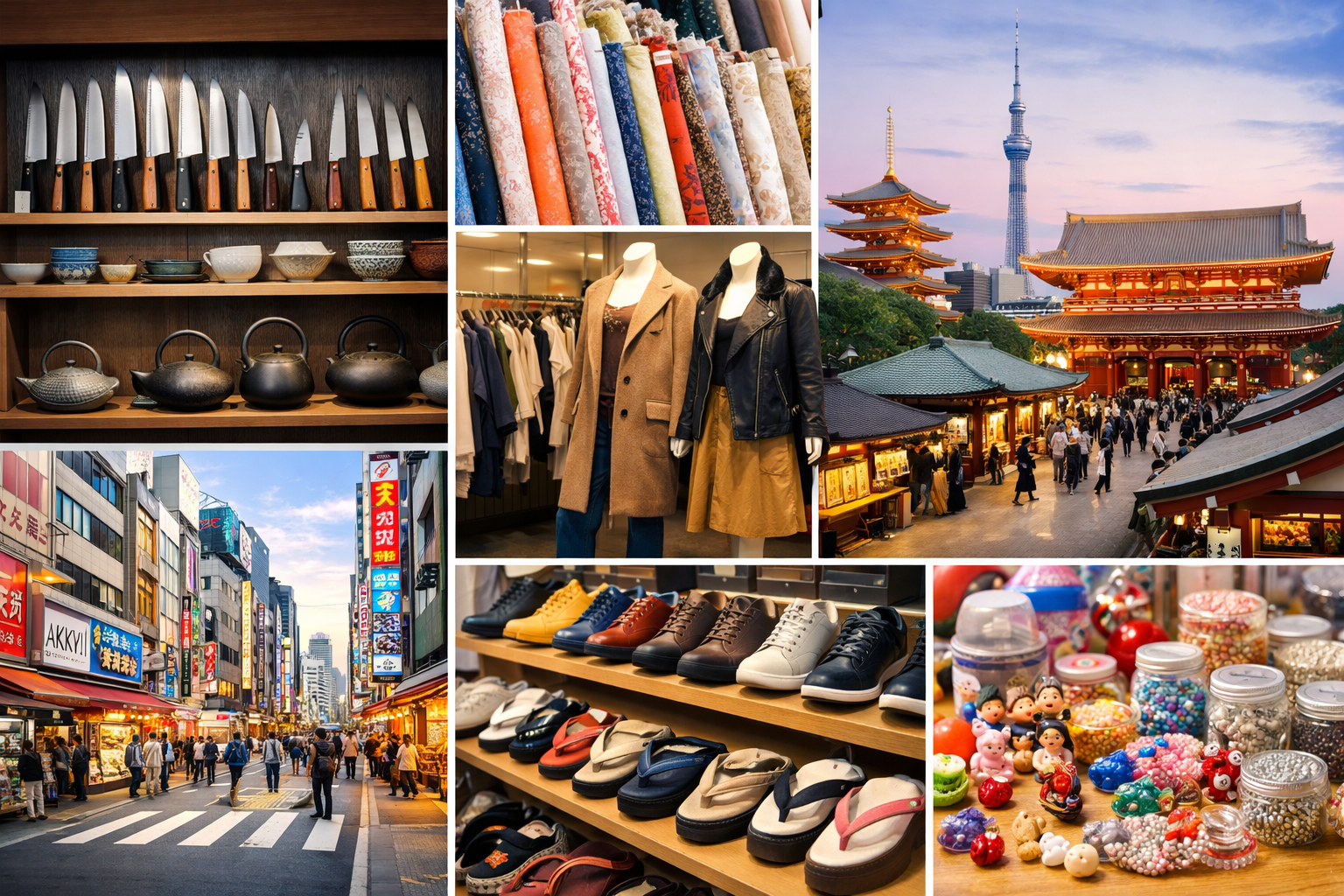
Tokyo is one of the best cities in Japan for in-person sourcing because it does not rely on a single wholesale zone. Instead, different neighborhoods specialize in different product categories, from kitchenware and fabrics to shoes, craft materials, and electronics. That makes Tokyo useful not only for overseas buyers and small shop owners, but also for travelers who want to buy well-made Japanese products locally instead of relying only on department stores or online marketplaces.
This guide is for three kinds of readers: travelers who want to buy quality Japanese goods in person, overseas buyers planning a sourcing trip, and small resellers looking for practical neighborhoods rather than polished shopping malls. Some of the areas below are easy for casual visitors, while others feel more trade-oriented. That difference matters, especially if you are visiting Japan for the first time and are not sure whether a district is retail-friendly or truly wholesale-first.
- Why Tokyo’s Wholesale Districts Are Worth Visiting
- The Best Tokyo Wholesale Districts by Product Category
- Kappabashi for Kitchenware, Tableware, and Restaurant Supplies
- Nippori Fabric Town for Fabric and Sewing Materials
- Bakurocho, Yokoyamacho, and Higashinihombashi for Fashion and Textile Wholesale
- Asakusabashi and Kuramae for Toys, Crafts, Beads, and Accessories
- Hanakawado / Asakusa for Shoes and Footwear
- Sourcing-Friendly Shopping Areas Beyond Traditional Wholesale Districts
- What Overseas Visitors Should Check Before Buying
- Which Tokyo Area Is Right for You?
- Final Thoughts
- Need Help Planning a Sourcing Trip in Tokyo?
Why Tokyo’s Wholesale Districts Are Worth Visiting
One of the biggest advantages of Tokyo’s wholesale areas is that you can see products in person before you buy. That matters for categories like ceramics, knives, fabrics, shoes, and craft materials, where texture, finish, weight, and detail are hard to judge online. Tokyo also gives buyers a mix of long-established specialist districts and newer sourcing-friendly shopping areas, so one trip can combine practical buying with product discovery. The second point is an editorial conclusion drawn from the different district profiles below.
Another reason these districts are useful is that not every area is trade-only. Kappabashi’s official FAQ says almost all stores sell to individual customers, and Nippori Fabric Town’s official Q&A says fabrics are sold to general customers in almost all stores. By contrast, the Yokoyamacho–Bakurocho area openly presents itself as Tokyo Fashion Wholesale Town with more than 400 trading companies and stores, so it is better approached as a more wholesale-oriented district.
The Best Tokyo Wholesale Districts by Product Category
Kappabashi for Kitchenware, Tableware, and Restaurant Supplies
Kappabashi is one of the easiest wholesale-style districts for overseas visitors to understand and enjoy. GO TOKYO says the district has around 160 shops, and most stores are open to the public. It is best known for:
- Japanese kitchen knives
- tableware and ceramics
- lacquerware
- cookware and cooking tools
- restaurant supplies
- plastic food samples
That combination makes Kappabashi useful for both serious buyers and travelers who simply want to bring home something well made. It is one of the few districts where a restaurant owner, a home cook, and a souvenir shopper can all have a productive visit.
If kitchenware is your main interest, you may also want to read our ultimate guide to Japanese kitchenware, knives, cast iron, ceramics, and more, which gives a broader overview of the types of Japanese kitchen items worth exploring beyond Kappabashi itself.
Overseas visitor notes
- Kappabashi is one of the most foreigner-friendly sourcing areas because almost all stores sell to individual customers.
- Payment methods vary by store, but official store pages in the district show examples of shops accepting cash, credit cards, electronic money, and QR payment.
- Kappabashi also has an official tax-refund counter system for partner stores, plus domestic and overseas delivery support through Smart Refund.
Nippori Fabric Town for Fabric and Sewing Materials
If your category is fabric, sewing materials, trims, or craft textiles, Nippori is one of the most practical districts in Tokyo. GO TOKYO describes the Nippori Textile District as a one-kilometer stretch with about 90 stores serving both personal hobbyists and wholesale buyers. It is best for:
- cotton, linen, and synthetic fabrics
- Japanese prints and traditional-style textiles
- ribbons, buttons, and notions
- sewing tools
- bag-making materials
- small-batch fabric shopping for designers and makers
Nippori is especially useful because it works for both professionals and non-professionals. A first-time traveler can browse and buy a few meters of fabric, while a small brand or maker can use the area for more serious material sourcing.
Overseas visitor notes
- Nippori’s official Q&A says fabrics are sold to general customers in almost all stores.
- The same Q&A says almost all shops can pack and send packages, which is useful if you are buying bulky materials from multiple stores.
- Payment methods vary by shop, but official shop pages do show stores with card acceptance. For example, Tomato Main Shop lists “Credit Card Available.”
- If you are buying for resale, the official Q&A says to ask each shop directly about wholesale conditions.
Bakurocho, Yokoyamacho, and Higashinihombashi for Fashion and Textile Wholesale
This is one of the most serious wholesale zones in Tokyo. The district presents itself as Tokyo Fashion Wholesale Town and says it has more than 400 trading companies and stores, especially in clothing, textiles, and related goods. It is best for:
- clothing and fashion basics
- textiles
- fashion accessories
- general goods
- more business-oriented sourcing visits
Compared with Kappabashi or Nippori, this area feels more trade-first. That does not mean overseas visitors should avoid it, but it does mean expectations should be different. This is a place to research, compare, and ask questions, not only to browse casually. The point that it feels more trade-oriented is an editorial inference based on the district’s official positioning.
Overseas visitor notes
- Treat this district as more wholesale-oriented than retail-oriented, and confirm store policies before visiting. That includes minimum order size, whether walk-in retail purchases are accepted, and whether small-lot buying is possible. This is practical advice inferred from the district’s wholesale identity, not a blanket rule stated for every store.
- If your interest is more in branded resale, vintage luxury, or secondhand fashion than in wholesale textiles, a better companion read is our guide to Japan used brand events and buying opportunities.
Asakusabashi and Kuramae for Toys, Crafts, Beads, and Accessories
Asakusabashi and nearby Kuramae are worth knowing if you are sourcing parts, craft materials, ornaments, or giftable goods. Taito City’s tourism guide describes the area as a traditional wholesale zone for toys and tool materials that now also includes beads, decorative items, and handicraft shops. It is best for:
- beads and accessory parts
- ribbons and decorative materials
- handcraft supplies
- toy-related goods
- doll-related products
- smaller creative sourcing
This is one of the most interesting districts for buyers who make or assemble products rather than simply buy finished goods. It is also appealing for travelers because it mixes wholesale history with creative browsing at street level.
Overseas visitor notes
- Store policies vary, but this is generally a better area for small creative buying than for very formal large-lot trade buying. That is an editorial conclusion based on the product mix and district character.
- Kuramae also works well as a design-led extension of this visit if you want maker-oriented or craft-adjacent Japanese goods rather than only classic wholesale browsing. That point is a practical recommendation based on the broader character of the neighborhood and nearby artisan activity.
Hanakawado / Asakusa for Shoes and Footwear
Hanakawado is more niche than Kappabashi or Nippori, but it is still worth including because it gives Tokyo a footwear-focused wholesale street. Taito City’s tourism site says Hanakawado Shoe and Footwear Wholesale Street is a wholesale shopping street lined with more than 70 shops handling shoes, bags, and other leather goods. It is best for:
- shoes
- sandals
- leather-related goods
- bags
- practical everyday footwear
This is a strong stop for readers who already care about Japanese footwear, especially comfort-oriented and local styles that may be easier to appreciate in person than online.
If footwear is your category, you may also want to read our related guides to Japanese shoe brands and Kenkoh sandals and Japanese comfort footwear.
Overseas visitor notes
- Hanakawado is useful if you want to see practical Japanese footwear in person rather than only shop department-store brands.
- Because this is a smaller niche district, it is smart to check store hours and product focus before going. That advice is practical inference rather than a rule published for the whole street.
Sourcing-Friendly Shopping Areas Beyond Traditional Wholesale Districts
Akihabara for Electronics, Gadgets, and Tech Shopping
Akihabara is not a classic wholesale district in the same way as Kappabashi or Nippori, but it is still extremely useful for visitors who want to buy Japanese electronics, device accessories, retro games, computer parts, or tech-related goods in person. GO TOKYO says the area began as a small zone densely packed with 1,000 electronics stores and remains full of shops selling computers, anime, manga, games, and more. It is best for:
- electronics and gadgets
- computer-related goods
- retro games and parts
- cameras and devices
- tech shopping with immediate comparison across stores
For travelers and small buyers, Akihabara is best treated as a sourcing-friendly retail district rather than a pure wholesale town.
Overseas visitor notes
- Akihabara is easy to visit, but the product mix is broad and not every shop is suitable for business buying. Go with a clear category in mind. This is practical advice based on the scale and diversity of the district.
- If tax-free shopping matters, check each retailer individually and remember that eligibility rules are specific.
Kitasando and Sendagaya for Fashion Showrooms and Design-Led Visits
Kitasando and Sendagaya should not be described as classic wholesale districts, but they are still worth knowing for fashion-focused visitors. Time Out describes Sendagaya as a creative neighborhood with fashion brands, while another Tokyo-based feature describes the district as a long-standing hub for design studios and fashion showrooms. This area is best approached as a fashion-adjacent business and showroom zone rather than a conventional wholesale street.
It is best for:
- fashion-business exploration
- showrooms and textile sample visits
- quieter brand discovery near larger fashion hubs
- buyers who want to combine Harajuku or Omotesando with lower-key research stops
Because it sits close to major fashion neighborhoods, Kitasando and Sendagaya can work well as a side route for buyers who are not only looking for wholesale buildings, but also for creative brands, studio culture, and showroom visits.
What Overseas Visitors Should Check Before Buying
Before visiting any of these areas, it helps to remember that “wholesale district” does not mean every store works the same way. Policies vary widely from shop to shop, even within the same neighborhood.
- Retail or wholesale?
Kappabashi and Nippori are relatively easy for individual customers, but more trade-oriented districts may require advance confirmation. - Minimum order quantity
Some shops are happy with small purchases, while others are better for larger orders. In places like Nippori, official guidance says wholesale conditions should be checked directly with each store. - Card or cash?
Many stores in Kappabashi and Nippori do accept cards, but you should not assume this across an entire district. Official store pages in both areas show that payment methods are listed individually. - Shipping and packing
Nippori says almost all shops can pack and send purchases, and Kappabashi’s Smart Refund counter offers domestic and overseas delivery support. - Tax-free shopping
GO TOKYO says tax exemption is available only to eligible non-residents such as foreign nationals with “Temporary Visitor,” “Diplomat,” or “Official” status. The same official guide says you must present your passport at purchase and at departure. For commercial buyers, the key practical point is that tax-free shopping is a traveler system, not a substitute for business import procedures. - Opening days and hours
Kappabashi says most stores are open on Saturdays but only about 30 percent on Sundays, while Nippori says there are no fixed holidays for the whole district and recommends checking each store.
Which Tokyo Area Is Right for You?
Here is the simplest way to think about it:
- For kitchenware, knives, and restaurant supplies: Kappabashi
- For fabric, trims, and sewing materials: Nippori Fabric Town
- For fashion wholesale and trade-oriented sourcing: Bakurocho, Yokoyamacho, and Higashinihombashi
- For beads, toy-related goods, dolls, and creative supplies: Asakusabashi and Kuramae
- For footwear and leather goods: Hanakawado / Asakusa shoe district
- For electronics and gadgets: Akihabara
- For fashion-adjacent showrooms and quieter creative visits: Kitasando and Sendagaya
Final Thoughts
Tokyo’s wholesale and sourcing neighborhoods are useful because they are specialized. You do not need to treat the whole city as one giant shopping area. A better approach is to decide what you want to buy first, then choose the district that matches that category. Kappabashi is one of the best entry points for travelers, Nippori is ideal for fabric and craft-minded buyers, Yokoyamacho and Bakurocho make more sense for trade-focused fashion sourcing, and Hanakawado is worth knowing if footwear is your category. Akihabara and Kitasando/Sendagaya are not classic wholesale streets, but they are still valuable side routes depending on what you are trying to source.
Need Help Planning a Sourcing Trip in Tokyo?
If you are planning a buying trip to Tokyo and are not sure which wholesale district fits your product category, I can help you narrow down the right areas, compare sourcing options, and support your Japan buying trip through my Fiverr Japan sourcing service.
コメント