


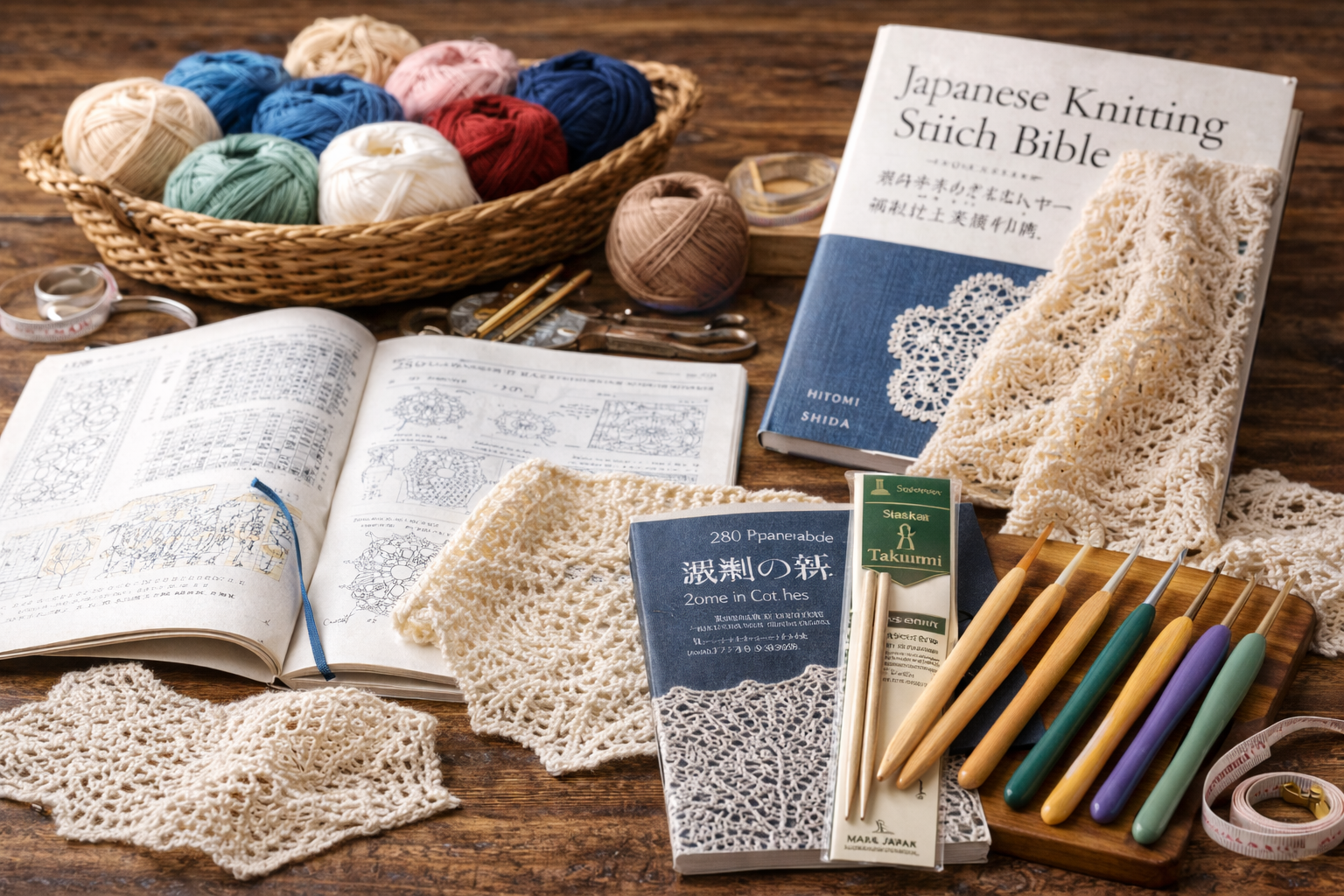
If you’re searching “knitting in Japan” or “Japanese knitting stitch”, you’re probably looking for one of three things: (1) why Japanese knitting patterns feel so clean and chart-friendly, (2) where the famous Japanese stitch dictionaries and lace motifs fit into modern knitting, and (3) which Japanese knitting needles (especially bamboo) are worth buying—and where. This guide is the “hub” post you can link from your Japanese Craft: A Complete Guide pillar, and it also points you to practical shopping routes and tools comparisons.
If you’re planning to shop in Tokyo for needles, yarn, and notions, save this: Tokyo Craft Shopping: Yuzawaya + Nippori. And if you want the direct tool deep-dive, jump to: Japanese Knitting Needles Comparison.
- Why “Knitting in Japan” Is a Thing People Search For
- What Makes Japanese Knitting Style Stand Out
- Japanese Pattern Culture
- Tools Spotlight: Japanese Bamboo Needles
- Where to Buy Knitting Needles in Japan
- Keito Dama: Japan’s Iconic Knitting Magazine
- Buying from Overseas: Common Friction Points (and Solutions)
- Want Help Sourcing Knitting Tools from Japan?
Why “Knitting in Japan” Is a Thing People Search For
When people look up knitting in Japan, they’re usually after one (or more) of these:
- Japanese pattern aesthetics (clean geometry, lace, wearable basics)
- The “diagram-first” pattern culture (stitch dictionaries, chart-driven books)
- High-quality Japanese tools—especially bamboo needles
This article is the big-picture overview you can link from your Japanese Craft guide pillar, and it sets up easy spin-offs like a needles buyer guide and lace stitch roundups.
If your readers also crochet, link laterally here: Crochet in Japan.
What Makes Japanese Knitting Style Stand Out
Japanese knitting has a reputation for:
- Structured pattern presentation (charts, symbols, repeat logic)
- Beautiful finishing (clean edges, thoughtful shaping)
- Motif and texture libraries (stitch dictionaries are a major sub-genre)
A lot of international knitters discover Japanese knitting through translated stitch dictionaries, then graduate to Japanese magazines and original pattern books.
For another Japan-first textile technique (less “garments,” more “stitch art”), see Sashiko for Beginners.
Japanese Pattern Culture
Japanese Stitch Dictionaries: The Gateway to Pattern Culture
If you’ve ever seen titles like “Japanese lace stitch dictionaries,” that’s not a niche—it’s a whole lane. A well-known English example is 280 Japanese Lace Stitches, which explicitly positions itself around “Japanese knitting” patterns and explanations.
Why stitch dictionaries work so well for global audiences:
- You can use them as a “pattern ingredient library”
- You don’t need to knit an entire garment to benefit—just borrow a stitch panel, edging, or motif
If your readers are buying tools to match these patterns, point them to: Japanese Knitting Needles Comparison.
Japanese Lace Knitting: Why It’s So Popular
Japanese lace knitting tends to emphasize:
- crisp motif definition
- balanced negative space
- stitch patterns that look intricate but are built on repeatable logic
This is one reason lace stitch dictionaries travel so well internationally: you can plug the motifs into scarves, shawls, socks, yokes, or panels without needing the original garment context.
For a “fabric + finishing” adjacent craft lane, cross-link: Quilting in Japan.
Tools Spotlight: Japanese Bamboo Needles
Japanese knitting tools—especially bamboo—are a big reason this keyword exists. Bamboo needles are often loved for:
- warm hand feel (less “cold” than metal)
- quiet knitting
- smooth surfaces that still offer control
Seeknit (Kinki Amibari, Nara)
Seeknit is the brand name used by Kinki Amibari, a long-established Japanese knitting needle company that notes its long history and bamboo craft roots in Nara. They also run an official store with clear manufacturer identity and contact info—helpful when you want reliable sourcing and SKU accuracy.
If your audience wants an apples-to-apples brand breakdown, send them here:
Why Japanese Knitting Needles Are a Game Changer (Seeknit vs Clover vs Tulip).
Clover “Takumi” (Made in Japan bamboo)
Clover’s Takumi line is widely associated with bamboo needles, and product listings commonly specify Made in Japan bamboo construction for circular needles.
If your readers are also hook users, you can cross-link to: Crochet in Japan (same “Japan tool quality” appeal).
Where to Buy Knitting Needles in Japan
What to look for when shopping (fast checklist)
- Material: bamboo vs metal (bamboo is the “Japan classic” for many)
- Tip shape: sharper tips help lace; rounder tips help general knitting
- Join quality (for circular/interchangeable): smooth joins reduce snagging
- Consistent sizing & labeling: crucial for gauge-sensitive patterns
Places to buy
- Brand official sources (best for correct variants and consistent naming)
- Seeknit / Kinki Amibari official pages + store info
- Large craft retailers (great for browsing in person)
- Yuzawaya’s global shop lists Clover Takumi needle sets (useful if you want a Japan-based retail source that already has an English storefront)
If your readers are traveling, the easiest “buy it in one day” route is:
Tokyo Craft Shopping: Yuzawaya + Nippori Fabric Town.
Keito Dama: Japan’s Iconic Knitting Magazine
If you want the “Japan knitting scene” in one place, Keito Dama is a key reference point. Nihon Vogue notes Keito Dama as a quarterly publication and positions it as a go-to hand-knit/needlework magazine with seasonal works and broad craft coverage.
Content-wise, it’s valuable because it can act like a trend snapshot:
- what silhouettes are “in”
- what yarn weights and textures are popular
- how Japanese designers present patterns and styling
If you also publish a “where to buy Japanese craft books” hub later, this section becomes a perfect internal-link anchor.
Buying from Overseas: Common Friction Points (and Solutions)
If you’re outside Japan, the usual pain points are:
- Japanese-only checkout on some stores
- variants that look similar (especially interchangeable systems)
- buying across multiple shops (needles here, yarn there, books elsewhere)
Most practical solution: plan a “bundle list” first (needle type + sizes + cables/accessories + a reference book), then source from 1–2 reliable places—or use consolidation if you’re mixing brands.
If they’re also sourcing other Japanese craft materials, these two guides pair well:
- Washi Paper Crafts in Japan (lightweight, easy-to-ship materials)
- Origami Paper from Japan (giftable paper bundles)
Want Help Sourcing Knitting Tools from Japan?
If you want Japanese knitting needles (Seeknit, Clover Takumi), accessories, or Japanese publications, and you’d like help with purchasing, consolidation, and international shipping, my Fiverr Japan Sourcing Gig can support:
- finding the correct needle system/variants
- purchasing from Japanese shops
- consolidating multiple orders into one shipment
- basic inspection (sizes, quantities, accessories)
コメント