


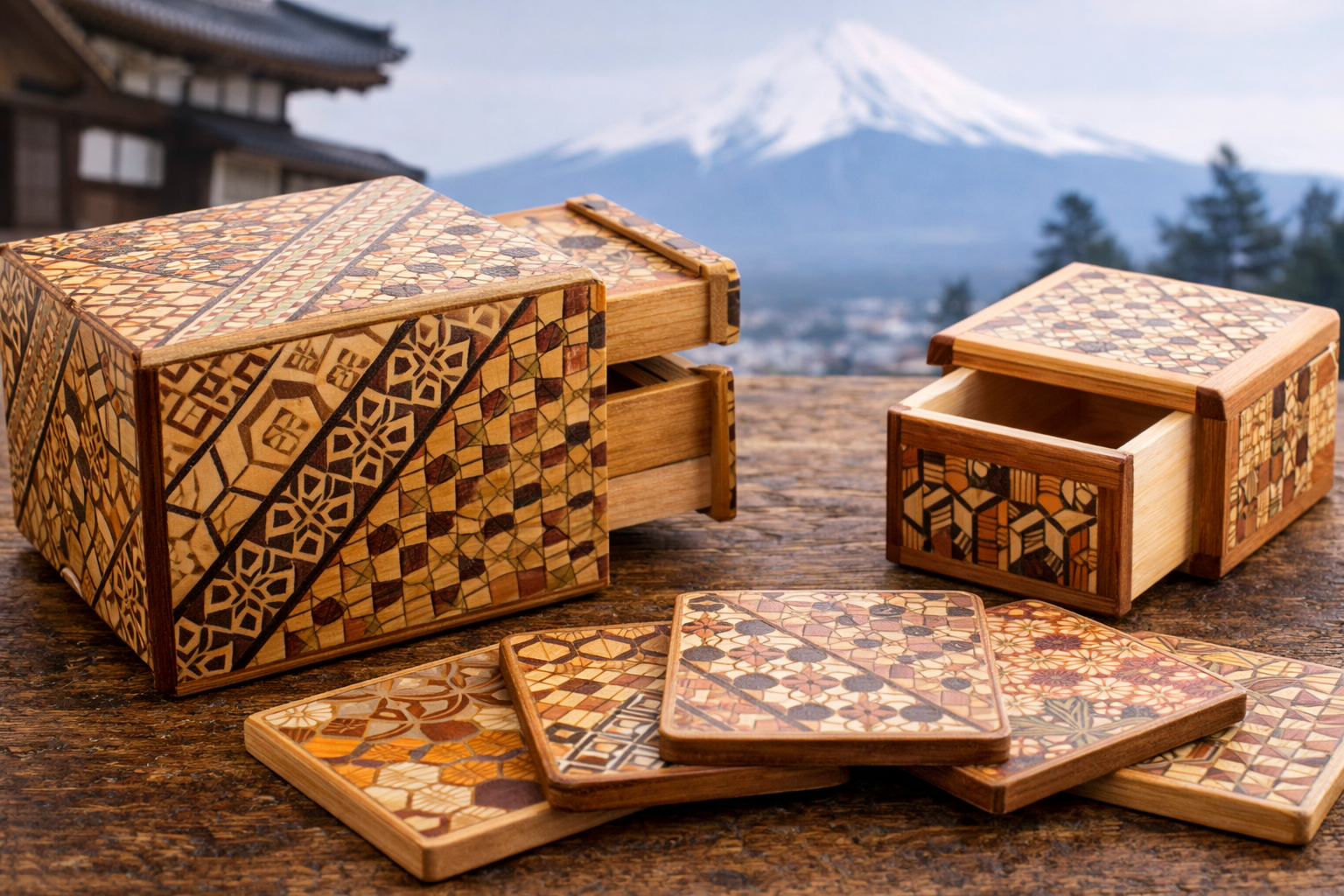
If you’re searching “Japanese Hakone marquetry”, “Hakone Yosegi Zaiku”, “Yosegi puzzle box”, or “where to buy authentic Yosegi”, this guide is built for buyers and travelers who want the real thing—not a random souvenir. You’ll learn what Yosegi-Zaiku is, why Hakone is the home of the craft, what to buy (from Himitsu-bako puzzle boxes to daily-use trays), how to spot quality, and how to plan an easy Hakone day trip from Tokyo. We’ll also cover overseas shipping and sourcing strategies.
For the bigger context, start here: Japanese Craft: A Complete Guide. If you’re planning a Tokyo-based craft day before Hakone, pair this with Tokyo Craft Day: Aoyama Square + Mingeikan + Ginza Takumi.
- What is Yosegi-Zaiku?
- Why Hakone became the home of Yosegi
- How Yosegi is made (in simple terms)
- What to buy: puzzle boxes, coasters, trays, and more
- How to choose a quality piece (authenticity + finish checklist)
- Hakone Yosegi day trip from Tokyo (easy route)
- The Yosegi “core area”: Hatajuku
- Best Yosegi workshops in Hakone (hands-on experiences)
- Where to buy authentic Yosegi-Zaiku in Hakone (shop types + reliable directories)
- Can I buy Yosegi in Tokyo?
- Packing, shipping, and overseas buying tips
- FAQ
- Related Guides (Internal Links)
- Want help sourcing and consolidating Yosegi purchases from Japan?
What is Yosegi-Zaiku?
Yosegi-Zaiku (寄木細工) is a traditional Japanese woodcraft that forms precise geometric patterns by combining woods in their natural colors—no paint needed. The Hakone tourism/craft site describes Hakone-Yosegi-Zaiku as a technique that uses the natural colors of various trees and “gathers” them together to create elaborate geometric patterns.
Internationally, you’ll often see it called Hakone marquetry because the craft is strongly associated with Hakone.
If you’re building your overall Japan craft “regional specialties” cluster, Yosegi pairs well with:
- Japanese Basketry Explained (wood/bamboo daily-life crafts)
- Hagi-yaki vs Kutani-yaki (another “regional craft buyer guide”)
Why Hakone became the home of Yosegi
Hakone is a perfect match for Yosegi for three simple reasons:
Material environment
The Hakone mountain area is described as having excellent tree species, which matters because Yosegi’s “palette” comes directly from wood varieties.
A craft village identity
Hatajuku is described as the birthplace of Hakone-Yosegi-Zaiku, with a local cluster of workshops, hands-on experiences, and museums.
Traveler demand
Hakone-Yumoto and surrounding areas are established sightseeing/shopping zones where visitors often look for “Hakone-only” souvenirs and crafts—including parquetry/marquetry.
If you want to turn this into a broader craft trip theme, link from your Tokyo itinerary here: One Day in Tokyo for Japanese Craft Lovers → “Add Hakone Yosegi as a day trip.”
How Yosegi is made (in simple terms)
You don’t need the full technical manual to shop well. Here’s the clear mental model:
- Choose woods with naturally different colors and grains
- Assemble a pattern block (a wooden mosaic bundle)
- Slice thin veneers from the block
- Apply the veneer to a base form (box, tray, coaster, etc.)
- Finish and polish so the surface and edges feel clean and durable
This is why quality Yosegi can look almost “printed”—the pattern is engineered first, then repeated via veneer slices.
Buyer insight: this also explains why cheap Yosegi can look “off”—pattern alignment and veneer finishing are where quality shows up immediately.
What to buy: puzzle boxes, coasters, trays, and more
Himitsu-bako puzzle boxes (the iconic Yosegi item)
If you want the most recognizable Yosegi purchase, it’s the Himitsu-bako (puzzle box/“secret box”). It’s compact, unmistakably Hakone, and the feel of the mechanism quickly tells you whether a piece is well-made.
Buying tip: don’t chase the highest number of steps as a beginner. A smooth, satisfying mechanism is more important than extreme difficulty.
Coasters (best first purchase)
Coasters are the easiest win: affordable, packable, and they let you enjoy Yosegi daily. They’re also great “test pieces” to evaluate finishing quality without committing to higher prices.
Trays and accessory boxes (daily-use upgrades)
These give you Yosegi’s beauty without any moving parts—great for gift buyers who want “pretty and practical.”
Larger pieces (drawer boxes, chests)
Beautiful, but you’re now in “plan shipping” territory—weight, edges, and corner damage risk go up fast.
How to choose a quality piece (authenticity + finish checklist)
Craft quality checklist (works for any Yosegi item)
- Pattern alignment: geometry stays crisp at seams and corners (no drifting lines)
- Surface finish: smooth, even sheen; no roughness on edges
- Veneer stability: no lifting, bubbling, or obvious gaps
- Corner/edge work: corners should feel tight and protected, not fragile
Puzzle-box checklist (extra checks)
- Mechanism smoothness: steps move cleanly (not gritty, not “sticky”)
- Tolerance: not too loose (cheap feel) and not too tight (risk of jamming)
- Repeatability: it should feel consistent every time you open/close
Provenance checklist (fast authenticity shortcut)
Clear shop identity (address/phone/hours) and transparent product descriptions are a green flag—and Hakone maintains official shop listings that help with that.
Pro tip: take photos of the item, the shop card, and any maker label. It makes later sourcing (or reordering) dramatically easier.
Hakone Yosegi day trip from Tokyo (easy route)
A practical “no-stress” plan is:
Tokyo → Hakone-Yumoto → (bus/transfer) Hatajuku area → shop + workshop → Hakone-Yumoto → Tokyo
Hakone-Yumoto is commonly treated as the gateway station area for Hakone travel and onward movement.
Planning tip: don’t over-engineer exact trains in the blog post—most readers will confirm day-of times in route apps. Your job is to explain the logic of the route and what to prioritize.
If your reader is building a Tokyo-to-Hakone craft storyline, connect it to:
Tokyo Craft Day: Aoyama Square + Mingeikan + Ginza Takumi.
The Yosegi “core area”: Hatajuku
If you want Yosegi in its “native environment,” aim for Hatajuku. Hakone’s Yosegi site positions Hatajuku as the birthplace of Hakone-Yosegi-Zaiku and notes that the area has Yosegi-related facilities like workshops, hands-on programs, and museums.
Why this matters: visiting the “core area” gives you better provenance confidence and makes it easier to compare quality across shops.
Best Yosegi workshops in Hakone (hands-on experiences)
Workshops are the fastest way to become a smarter buyer.
Yosegi-Zaiku hands-on workshop (coaster-making)
Hakone’s official Yosegi experience page describes a hands-on class where visitors make a Yosegi coaster and can take it home (popular and beginner-friendly).
Important note: the official page also indicates that advance reservations are required for many experiences—so treat workshops as “book first, then build the day around it.”
Why do the workshop first? You’ll immediately understand how patterns and finishing work—then you’ll shop with sharper eyes.
Where to buy authentic Yosegi-Zaiku in Hakone (shop types + reliable directories)
Use the official Yosegi shop directory first (best for verified basics)
Hakone maintains a Yosegi shop directory with store names and practical info (hours/holidays/address/phone). It’s a great “buyer confidence” starting point because it reduces random-shop guessing.
Flagship-style specialty store: Hakone Maruyama
Hakone’s featured shop page for Hakone Maruyama lists clear details including 9:00–17:00 and “without holiday.”
This type of store is ideal if you want to compare many items side-by-side (including puzzle boxes) before choosing.
Shops that explicitly offer overseas shipping (good for larger purchases)
If you’re planning to buy anything big (or you’re worried about safe packing), prioritize shops that clearly state overseas shipping availability—e.g., Hakone’s page for Yosegi-Zaiku Store IZUMIYA notes “Overseas shipping available.”
Can I buy Yosegi in Tokyo?
Sometimes—through curated craft shops, department-store craft corners, and “Japan craft” select stores. But the safest buyer framing is:
- Hakone = strongest provenance + best selection
- Tokyo = convenient, but selection varies
So for SEO and user experience, treat Tokyo as “possible,” and Hakone as “recommended.”
If your reader is Tokyo-based and wants a “shopping-first” day, point them to:
Tokyo Craft Day: Aoyama Square + Mingeikan.
Packing, shipping, and overseas buying tips
Packing (travelers)
- Puzzle boxes: carry-on friendly; wrap with soft cloth; keep away from heavy items
- Coasters/trays: stack with a rigid layer to protect corners
- Large boxes/drawer pieces: don’t gamble—ship
Shipping (overseas buyers)
- Ask for edge protection + padding
- Consider insured shipping for expensive pieces
- Photograph: the item + any label/card + receipt (helps future sourcing and reorders)
A smart “don’t overbuy” rule
Buy one hero piece you truly love, then small giftables. Yosegi rewards attention—rushed shopping leads to regret buys.
If your audience is also buying lightweight, shippable craft gifts, link to:
FAQ
Is Yosegi-Zaiku the same as marquetry?
It’s closely related. Yosegi is a distinctive form of wooden mosaic/marquetry strongly tied to Hakone, emphasizing repeatable geometric patterns made from natural wood colors.
Are puzzle boxes truly part of Hakone Yosegi culture?
Yes—Himitsu-bako are among the most widely recognized Yosegi products associated with Hakone and commonly featured by Hakone craft/travel sources and specialty stores.
Is there a “best” place to start?
Yes: a coaster workshop + one reputable shop visit. You’ll understand the craft faster and buy better.
Related Guides (Internal Links)
- Japanese Craft: A Complete Guide
- Tokyo Craft Day: Aoyama Square + Mingeikan + Ginza Takumi (Tokyo craft context + buying)
- Japanese Basketry Explained (wood/bamboo daily-life crafts)
- Hagi-yaki vs Kutani-yaki (regional craft buyer guide)
- Japanese Temari Ball Explained (giftable, easy to ship)
Want help sourcing and consolidating Yosegi purchases from Japan?
If you want Yosegi—especially specific puzzle boxes, matching sets, gifts in quantity, or pieces that need careful packing—I can help via my Fiverr Japan Sourcing Gig with:
- purchasing from Japanese shops
- consolidation into one shipment
- basic inspection (finish quality, correct variant/size, mechanism check for puzzle boxes)
- international shipping coordination

コメント