


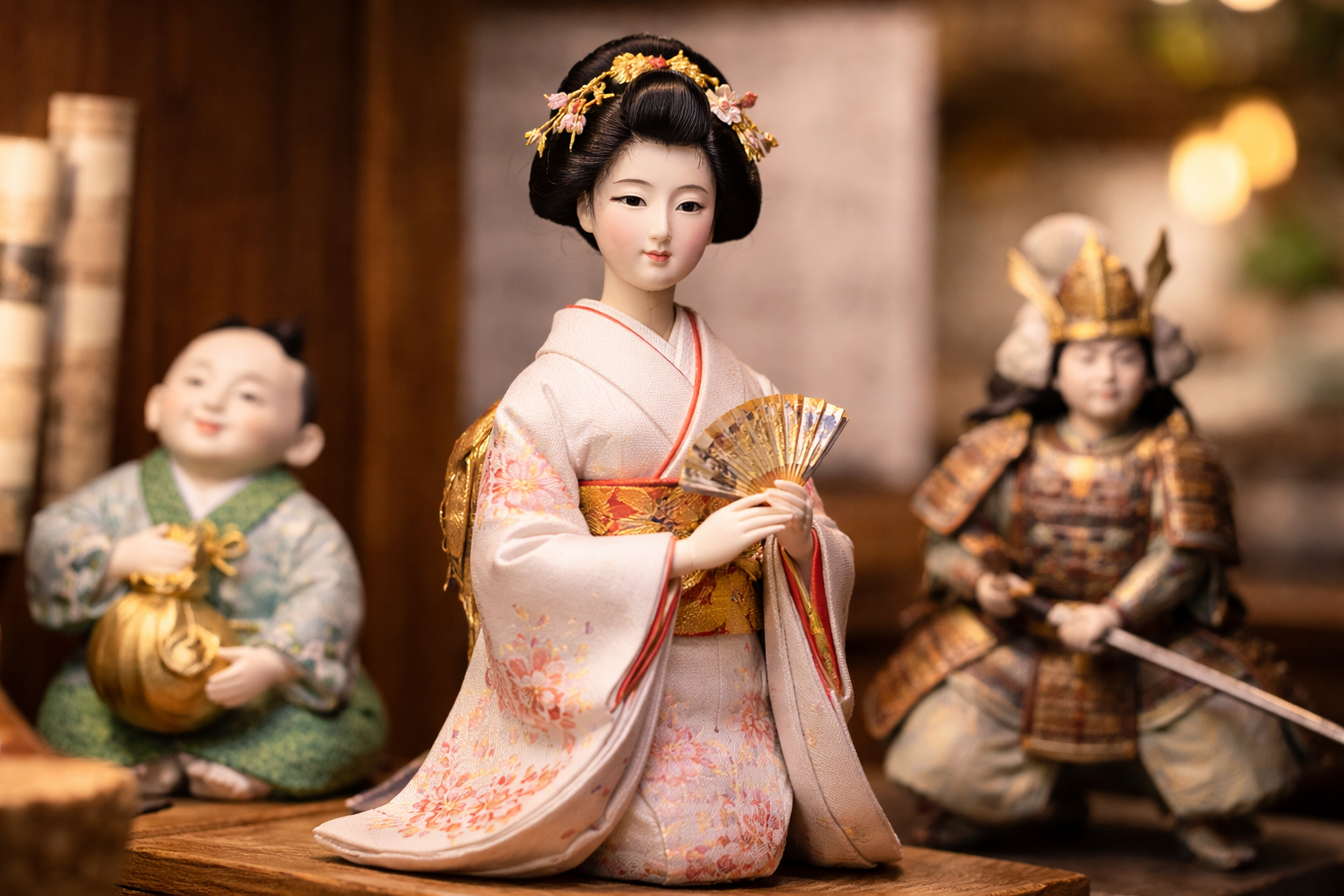
If you’re searching “Hakata dolls Fukuoka”, “Japanese Hakata doll”, “Hakata Ningyo”, or “where to buy authentic Hakata dolls”, you’re likely looking for a collectible Japanese craft that feels deeply “made in Japan”: hand-modeled unglazed clay, soft matte coloring, and incredibly delicate facial expression and kimono detail. This guide explains what Hakata dolls are, how to recognize quality, where to shop in Fukuoka (and what Tokyo options look like), and how to ship them safely overseas.
For the broader craft map, start here: Japanese Craft: A Complete Guide. If you’re planning a Tokyo craft day (and want to compare different crafts before buying), see One Day in Tokyo for Japanese Craft Lovers.
- What are Hakata dolls (Hakata Ningyo)?
- Why Hakata dolls are special (materials + look)
- A quick history (from local craft to global exhibitions)
- Common Hakata doll types (what you’ll see in shops)
- How to choose an authentic, high-quality Hakata doll
- Where to buy Hakata dolls in Fukuoka
- Can you buy Hakata dolls in Tokyo?
- Packing, shipping, and overseas buying tips
- FAQ
- Want help sourcing and consolidating Hakata dolls from Japan?
What are Hakata dolls (Hakata Ningyo)?
Hakata dolls (Hakata Ningyo) are traditional unglazed clay dolls from Hakata/Fukuoka, known for their soft, calm colors and delicately carved expressions.
A key point for buyers: unlike glazed ceramics, Hakata dolls are often appreciated for the warm, matte surface and realistic facial nuance that comes from painting directly onto unglazed material.
If your readers are exploring Japanese crafts by material category, this fits neatly under “clay/ceramics”—but with a very different purpose than tableware. For a pottery comparison guide, link: Hagi-yaki vs Kutani-yaki.
Why Hakata dolls are special (materials + look)
When people fall in love with Hakata Ningyo, it’s usually because of:
- Unglazed, bisque-like warmth (the surface looks soft rather than shiny)
- Face sculpting and expression (subtle emotions, gentle realism)
- Kimono painting and fine detail (you’ll often see incredibly precise patterns)
What to notice in the first 10 seconds (buyer tip)
- Eyes and mouth: are they alive and intentional, not “flat”?
- Hands: fingers are hard to sculpt well—good pieces show control.
- Kimono pattern edges: clean borders are a strong quality signal.
A quick history (from local craft to global exhibitions)
Modern travel/craft guides commonly trace Hakata dollmaking back around 400 years, including foundations linked to early Fukuoka-domain history.
Hakata dolls also gained international attention after being exhibited at the 1900 Paris World Exposition, where they were recognized as a representative Japanese doll craft in global exhibitions.
Practical takeaway: Hakata dolls are not “new souvenir culture”—they’re part of an established craft lineage, which is why provenance and maker attribution matter.
Common Hakata doll types (what you’ll see in shops)
If you’re shopping (or browsing online), you’ll typically see categories such as:
- Bijin-mono (beauties in kimono)
- Warrior / heroic figures
- Children
- Lucky charms
- Noh / Kabuki-themed figures
- Seasonal dolls (e.g., hina / festival-related)
The Hakata Ningyo cooperative site lists these genre-like groupings as common classifications.
What’s easiest for first-time buyers?
- Small bijin or lucky charm styles: easiest to display, easier to pack, still very “Hakata.”
- If your reader wants “one statement piece,” they can level up to a larger bijin or dramatic kabuki figure later.
How to choose an authentic, high-quality Hakata doll
Use this buyer checklist—works in-store and for judging online listings/photos.
Craft quality checklist
- Face/hand carving: expressions look intentional, not flat
- Paint work: clean edges on patterns; no blotchy areas
- Surface finish: smooth matte feel; no obvious cracking
- Proportions: balanced posture and stable base (no wobble)
- Fine parts: sleeves, hair ornaments, and accessories should feel secure
Provenance checklist (fast authenticity shortcut)
- Buy from sellers with clear store identity (address/phone) and who can explain what they sell.
- Prefer dolls with maker/workshop info or documentation when available.
Online listing tip: ask for close-up photos of (1) face, (2) hands, (3) kimono pattern edge, (4) base/back stamp or label card.
Where to buy Hakata dolls in Fukuoka
1) Hakata Doll Hall Shogetsudo (Hakata / Nakasu area)
If you want a well-known, tourist-friendly place with clear practical info, Hakata Doll Hall Shogetsudo is listed by the official Fukuoka tourism site with address, phone, and hours (9:00–19:30).
Why it’s good for buyers: clear store identity + a focused Hakata doll environment makes provenance easier.
2) Hakata Traditional Craft and Design Museum (Hakata area)
For context + craft education (great before shopping), the Hakata Traditional Craft and Design Museum introduces Hakata Ningyo and other local crafts and notes a relocation/reopening in May 2025.
Smart buying strategy: museum first → shop second. You’ll understand what “good” looks like faster.
Can you buy Hakata dolls in Tokyo?
Yes—Tokyo’s official “Traditional crafts across the nation” portal includes a Hakata Ningyo page, which is a sign that the craft is recognized and presented through Tokyo-based craft education channels too.
Buyer logic remains:
- Fukuoka = best context + strongest local selection
- Tokyo = possible, but selection varies
If your reader is Tokyo-based and wants to compare multiple crafts in one day, link: Tokyo Craft Day: Aoyama Square + Mingeikan + Ginza Takumi.
Packing, shipping, and overseas buying tips
Hakata dolls are generally fragile (fine parts, delicate surfaces), so plan like a collector:
In-person (travelers)
- Ask for protective packing and keep the box if provided
- Place the boxed doll in your carry-on, not checked luggage when possible
Overseas shipping
- Prioritize rigid packaging + cushioning; consider insurance for higher-value pieces
- Ask for inner-box stabilization so the doll doesn’t move inside the outer box
Documentation
Photograph:
- the item
- any maker card/label
- your receipt
Reorders and sourcing are much easier when you have references.
Quick shipping script (copy/paste):
“Please pack in a rigid box with cushioning so the doll cannot move, and protect delicate parts.”
FAQ
Are Hakata dolls officially a “traditional craft”?
Yes—Fukuoka-focused guides note Hakata dolls were recognized as a nationally designated traditional craft (often cited as 1976).
What’s the easiest “first buy”?
A small bijin figure or lucky charm style is usually the safest: easy to display, easier to pack, and still very “Hakata.”
Are Hakata dolls ceramics?
They’re clay-based and fired, but the key buyer difference is the unglazed matte finish and the emphasis on sculpted expression and painted detail—closer to “art doll” culture than tableware.
Want help sourcing and consolidating Hakata dolls from Japan?
If you want Hakata dolls from Japan—especially for gift sets, bulk orders, careful inspection, or fragile-item packing—my Fiverr Japan Sourcing Gig can help with:
- purchasing from Japanese shops
- consolidation into one shipment
- basic inspection (variant, size, visible paint issues)
- international shipping coordination
コメント